

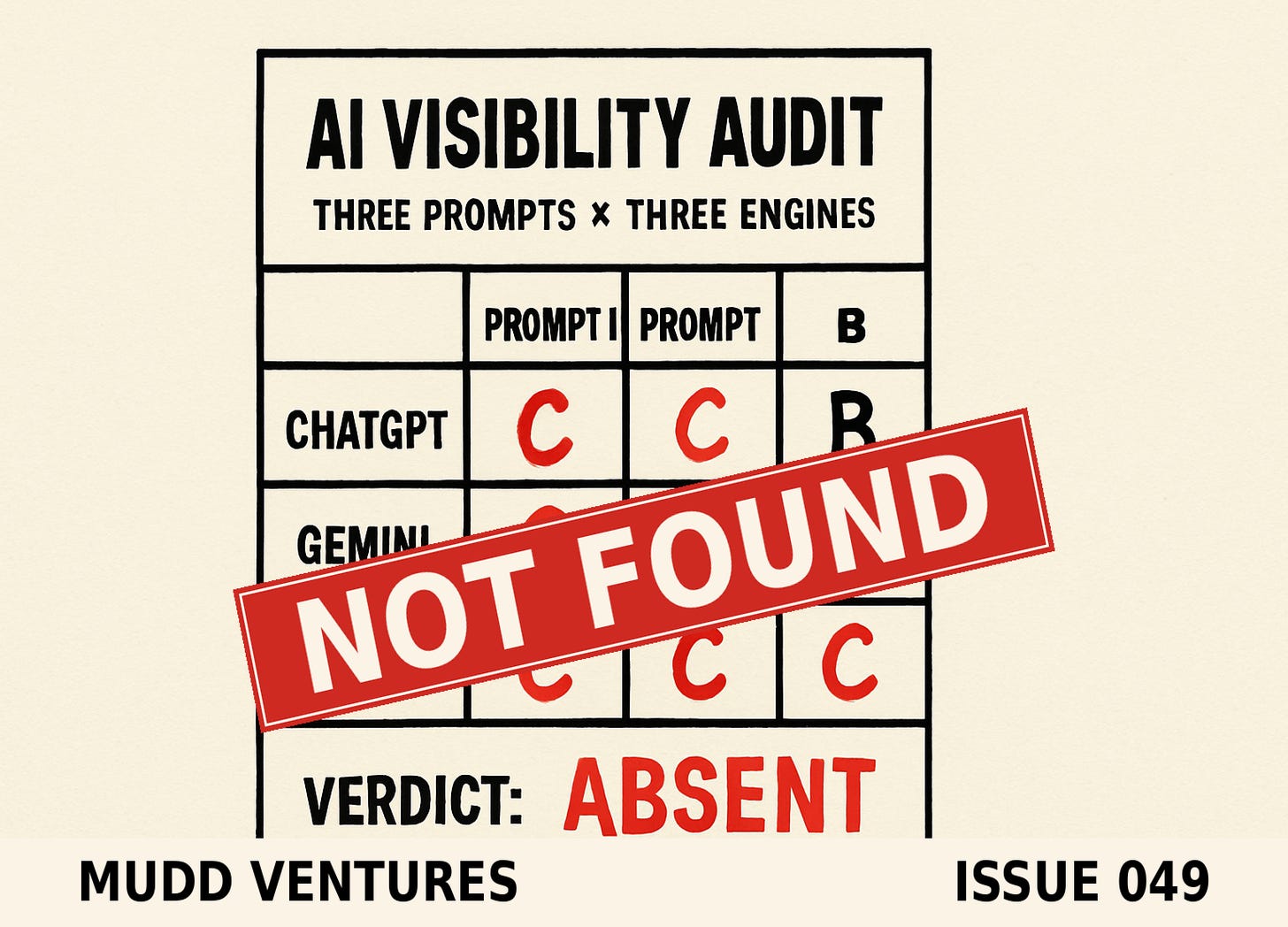
TLDR: Three separate startups launched the same product in the first week of July: tools that show businesses whether ChatGPT, Gemini, Claude, and Perplexity recommend them. One raised a €10 million seed round doing it. The pitch lands because most businesses have never once asked an AI what it says about them. You can run that first check yourself tonight, free, with three prompts. This issue gives you the exact audit, how to read what comes back, and the questions that separate a real vendor from a snake-oil retainer.
Monday's startup funding roundup had a pattern I've been waiting to see. Three companies launched the same product in the same week without knowing it: Foundin.ai in the Netherlands, GeoSurge in London, and Visiblie in Belgium, all building tools that show businesses whether they appear when someone asks an AI for a recommendation. GeoSurge closed a €10 million seed round on July 1. Visiblie raised €500K the next day. In StartupHub's words, "none of them appear to know the others exist."
I pay close attention to this lane because I build in it. Counterclaim, my skill pack for fixing what AI engines say about a business, exists because of the same shift these three startups just raised money on. Back in May I wrote about AI Visibility Drift, the gap between what your business actually is and what the answer engines say it is. What's new this month is the vendor layer forming on top of that gap. When three companies ship the same product in one week, the sales emails start landing in operator inboxes about six weeks later. Digiday reports GEO pitches are already flooding media execs' inboxes. Yours is next.
Here's what the pitch decks won't lead with: the first and most useful thing every one of these tools does is ask the AI engines about your business and show you the answer. That part is free. You can do it tonight.
By the end of this you'll have a 20-minute audit that produces a dated snapshot of what ChatGPT, Gemini, and Perplexity say about your business, a verdict system for reading it, and a four-question filter for any vendor who calls.
What's ahead:
The myth this category is priced on: your Google ranking tells AI engines a lot less than you'd think, and there's 75,000-brand data on it.
The 20-minute self-audit: three prompts, three engines, one dated document.
Three verdicts and the fix for each: including the one I'm naming today, because half the businesses that run this audit are going to hit it.
The vendor filter: four questions that collapse a snake-oil retainer pitch in one call.
Who this is for: operators whose customers ask ChatGPT or Perplexity for recommendations before they ever hit Google, which at this point means most local services, agencies, consultants, and B2B firms with a sales cycle.
The myth the whole category is priced on
The myth: if you rank well on Google, the AI engines already know you and recommend you. So AI visibility is either handled or hopeless, and either way there's nothing to do this quarter.
The data says otherwise, and it comes from an unlikely skeptic. Ahrefs, a company that sells traditional SEO software, studied 75,000 brands to find what actually correlates with getting mentioned by ChatGPT, Google's AI Mode, and AI Overviews. The classic SEO signals came back weak. Domain Rating, the authority score agencies charge you to raise, correlates with ChatGPT mentions at just 0.266. Backlink volume barely registers. Total pages on your site: almost nothing, around 0.194. Publishing more content for volume's sake does basically zero for AI visibility.
What correlated strongest surprised me when I first read it. YouTube mentions, at roughly 0.737 across all three AI surfaces, beat every other factor they tested. Any time your brand name shows up in a video title, transcript, or description, that's a signal. Branded web mentions came second at 0.66 to 0.71: your name appearing in articles, guides, forums, and directories, whether or not anyone links to you. The engines learned about the world partly from YouTube transcripts and web text, so the businesses that get talked about are the businesses that get recommended. Being talked about and ranking on Google are related, but they're very much not the same job.
One more finding worth holding onto: ChatGPT showed the weakest pull toward established brand authority of the three surfaces Ahrefs tested. For a business without a household name, it's the most open door. Google's AI Mode sits at the other end, acting like a consensus engine that mostly repeats whoever's already big.
So the myth cuts both ways. Your page-one ranking doesn't carry over the way you'd assume, and your lack of a big brand doesn't lock you out the way you'd fear. Which means the only way to know where you stand is to ask.
The 20-minute audit
The move: ask the engines about your business the way a customer would, from a clean seat. Open ChatGPT, Gemini, and Perplexity. Use a logged-out window or a fresh chat with no memory of you, because your own account has context that a stranger's doesn't.
The exact prompts. Run all three in each engine, nine answers total:
1. What are the best [your service] providers in [your city or market]?

2. I'm looking for [the specific thing you sell, phrased like a buyer:
   "a marketing agency for a home services company doing $3M"].
   Who would you recommend and why?

3. What do you know about [Your Business Name] in [city]?
   What do they do, and what is their reputation?
Paste all nine answers into one document. Put today's date at the top. That date matters more than it looks, because this snapshot is the baseline every future check gets compared against.
What a healthy result looks like: you show up unprompted in at least some of the recommendation answers, and when you're named directly in prompt 3, the engine describes your actual services, your actual market, and doesn't confuse you with anyone else. The description reads like a knowledgeable colleague summarizing you.
The failure mode: running it once, getting one bad answer, and treating it as a verdict. These engines are probabilistic. The same prompt can produce different answers an hour apart. One absent answer means nothing. A pattern across nine answers means a lot. If you want to be careful, run the set twice and keep both.
Walk away with: a dated nine-answer snapshot of what the answer engines tell your prospects about you.
Three verdicts, and the fix for each
The move: score each of the nine answers with one letter, then count.
A = PRESENT AND ACCURATE: named in recommendations, described correctly
B = PRESENT BUT WRONG: named, but services, market, or reputation off
C = ABSENT: not mentioned, or the engine says it doesn't know you
What the scorecard tells you. Mostly A: you're in maintenance mode, re-run monthly and watch for drift. A mix with B: you have a correction problem, which is exactly the AI Visibility Drift pattern from May, where the engines are working from stale or third-party information about you. Mostly C is the one that deserves a name, so I'm giving it one.
Institutional Absence is when the answer engines have no confident story about your business at all. Not a wrong answer, no answer. You ask prompt 3 and get a hedge, a guess, or a different company with a similar name. The engines aren't against you. They've simply never absorbed enough independent signal about you to say anything. Based on what I see when operators run this for the first time, absence is more common than distortion, and it's invisible until you look, because nothing in your Google Analytics tells you about the recommendation that never included you.
The fix lane, per verdict. For B, correction: tighten the sources engines actually read, meaning your Google Business Profile, your directory listings, consistent descriptions of what you do across every page that names you, and follow-up where third-party sites describe you wrong. For C, the Ahrefs data hands you the priority list. Get your name into video: guest spots on local or niche YouTube channels, recorded talks, even client walkthroughs, because low-view videos still count when the mentions are wide. Earn genuine text mentions: trade publications, local press, supplier case studies, community guides. And aim at ChatGPT first, since it's the surface least gated by brand size.
The failure mode: treating this like a week-long project. Mentions accumulate over months. An operator who starts now is buying position for Q4 and next year, not for next Tuesday. The other failure is buying a retainer to fix what's actually a listings problem you can clean up yourself in an afternoon.
Walk away with: a verdict letter and the single fix lane that matches it.
When paying a vendor actually makes sense
The category is real, and so is the snake oil forming around it. Jeremy Moser, who runs the SEO agency uSERP, gave Digiday the line I'd frame on the wall: "If a GEO service does not openly tell you that success in AI visibility is 80 percent good fundamental SEO, they are selling you snake oil." Lily Ray, VP of SEO at Amsive, put the vendor wave in context in the same piece: "We've all lived through this a million times, and that's why it's been frustrating for us." Her point is that AMP and featured snippets each spawned the same cottage industry of specialist vendors before getting absorbed back into ordinary search work.
There's also a hard structural limit the sales deck glosses over. Per Digiday's reporting, these tools don't have access to the real prompts people type into AI engines. They simulate queries with synthetic data and work backwards from outputs. That's a reasonable method, and it's also an estimate, sold with a dashboard's confidence.
The move: before signing anything, make the vendor answer four questions.
1. What share of your recommendations is fundamental SEO
   I might already be paying someone else for?

2. Do you see real user prompts, or do you model them synthetically?

3. Show me one client: what exactly did you change,
   and what moved in the 90 days after?

4. If I stop paying you, what happens to the visibility you built?
What a good answer sounds like: a real one will echo Moser unprompted, admit the synthetic-data limit, and point at durable assets like mentions, listings, and content that keep working after the contract ends. Where a vendor genuinely earns the fee is scale: dozens of locations, hundreds of prompts tracked weekly, competitive categories where manual checks can't keep up.
The failure mode: any guarantee of AI mentions. The engines are probabilistic and nobody controls their output. A guarantee on a system the vendor doesn't control tells you everything about the rest of the pitch.
Walk away with: a four-question filter that ends most of these sales calls inside ten minutes.
The honest tradeoffs
The audit is a snapshot, and the engines move. Answers shift by model version, by phrasing, by day. That's the Engine Drift problem wearing a different coat, and it's why the dated document matters more than any single answer.
AI visibility also isn't traffic, at least not yet. Ahrefs' own numbers show ChatGPT carries about 12% of Google's search volume while Google still sends 190x more clicks to websites. What AI answers drive today is the shortlist: who gets considered, who gets called. That's worth real money in high-ticket services, and it's hard to attribute in any dashboard you currently run.
And the correlation caveat is real. Ahrefs is careful to say YouTube mentions correlate with AI visibility; nobody has proven they cause it. The fix lanes above are the best-supported bets available, and they're still bets.
Recap
Three startups launched the same AI-visibility product in one week, which tells you the vendor wave is coming. The category prices itself on a myth, because Google rank and AI mentions are loosely related at best. The free move is the nine-answer audit: three prompts, three engines, one dated document, one verdict letter. B means correct your sources. C means Institutional Absence, and the fix is mentions, video first. Vendors earn their fee at scale, and the four questions above sort the real ones from the gold-rush ones.
If you run the audit and find the engines telling a wrong story, or no story, about your business, that's the exact job I built counterclaim.muddventures.com to handle, prompt by prompt, source by source.
FAQ
Do I also check Google's AI Overviews and AI Mode? Yes, same prompts. Just know the dynamics differ: Google's AI surfaces lean harder on established authority, so your existing SEO carries more weight there. ChatGPT is where an unknown brand has the fairest shot.
How often do I re-run this? Monthly, same prompts, same document. The trend line across snapshots is the real signal.
I run a local business. Does this matter yet? Foundin.ai built its whole product for local businesses, which tells you where the demand is. Your buyers are already asking these engines who to call. The volume is smaller than Google's, and the people asking are usually close to a decision.
Should I block AI crawlers from my site? If visibility is the goal, no. A blocked crawler can't learn what you do, and an engine that can't read you defaults to whatever third parties say, or to silence.
What if the AI says something flat-out false about my business? That's a corrections workflow: find the source it learned from, fix it there, then feed the engines updated signal. It's the core of what Counterclaim automates.
Tomorrow's issue is back in your inbox at the usual time. If you run the audit tonight, reply with your verdict letter, A, B, or C. I read every reply.
Andrew
P.S. If this issue hit, these go deeper: the original AI Visibility Drift breakdown on what Google's AI did to organic clicks, the Operator's Read on Engine Drift for why saved AI setups quietly change under you, a 2-minute AI IQ Test to see where your operation actually stands, and the Abra AI community where operators share the skill files behind builds like this. New here? Get the daily issue at muddventures.substack.com.