

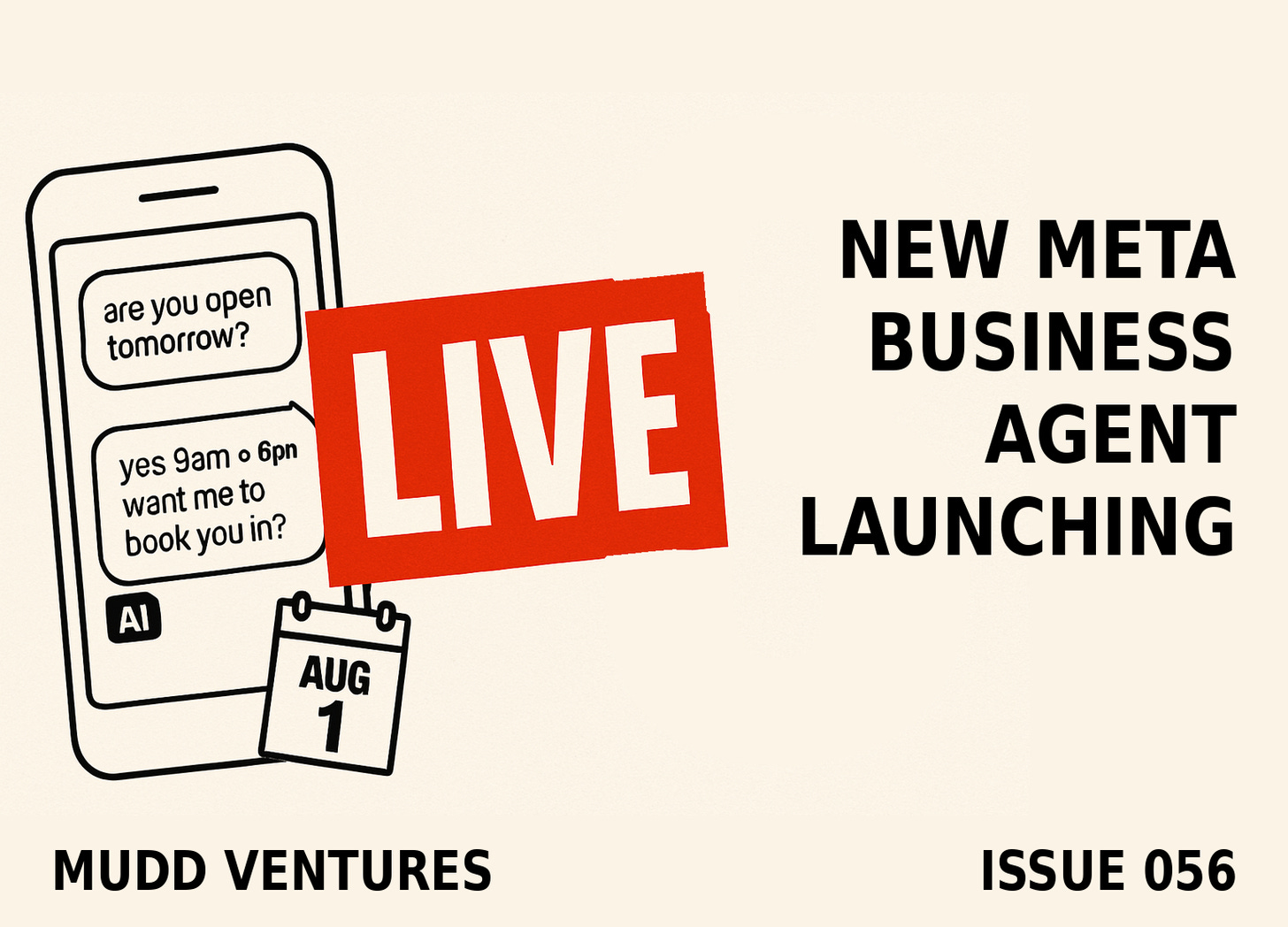
TLDR: Meta Business Agent is live for businesses of every size across WhatsApp, Messenger, and Instagram, and turning it on costs nothing today. The billing calendar is already public: the partner platform starts metering August 1 at roughly 4 to 5 cents per agent-handled message, and from October 1 every reply inside an open WhatsApp service window carries a charge. The free stretch is the cheapest month you’ll ever get with this tool, enough time to set the agent up in demo mode, break it with a test script, and learn what your real conversation volume would cost, so the paid era opens with your numbers instead of Meta’s estimates.
Every booking workflow I’ve built in GoHighLevel exists because of one number: the longer a lead sits unanswered in a message thread, the deader the deal gets. I spent years on the agency side watching that decay eat perfectly good pipeline, a lead messages at 9pm, the reply lands at 10 the next morning, and the thing they were ready to buy the night before has cooled into “let me think about it.” Entire product categories exist to shave minutes off that gap.
Which is why the part of Meta’s announcement that got me had nothing to do with the AI itself. Meta ran its Conversations event in London on June 3 and turned on Meta Business Agent for businesses of every size, an agent that answers customer questions, recommends products from your catalog, books appointments, qualifies leads, and closes sales inside WhatsApp, Messenger, and Instagram threads. Free to activate, live in minutes, already working for more than a million businesses. Then, four weeks later, the billing schedule showed up with real dates on it.
By the end of this you’ll have the agent running in demo mode, a ten-message script for breaking it before customers find the gaps, and your own cost estimate for the metered era before Meta sends anyone an invoice.
That free-then-billed sequence deserves a name, so I’m coining one: The Meter Flip. A platform gives an AI capability away long enough for a million businesses to wire it into daily operations, then turns the meter on against a published schedule. It’s the same absorption pattern I wrote about when Notion made Zapier optional, a native feature swallowing what used to be a paid vendor, with one difference that changes how you play it: this time the free part has a printed expiration date, and the first of those dates is two weeks out.
Free today, with paid tiers already promised. Meta’s own newsroom says getting started costs nothing and that “paid subscription offerings” arrive in the coming months.
The platform meter starts August 1. $2.00 per million tokens, which Meta translates to roughly 4 to 5 cents per agent-handled message, one blended charge covering the AI and the message delivery.
From October 1 there is no free reply left on WhatsApp. Human, template, or agent, every response inside an open service window gets billed.
The math is knowable this month. A test script and three weekly numbers tell you what the paid era costs before it starts.
Who this is for: operators whose customers already message them on WhatsApp, Instagram, or Messenger, and anyone paying a chatbot vendor or an answering service to cover those same threads.
What Meta turned on
Meta’s pitch line is “AI that lets every business show up for every customer as if they had an infinite team behind them,” and the capability list in the announcement backs most of that up: it answers questions specific to your business, makes product recommendations from a catalog, books appointments and qualifies incoming leads, lets you decide when a team member steps in, and closes sales. More than a million businesses were running it on WhatsApp and Messenger in markets like Brazil, India, and Mexico before the global expansion, and Meta counts over a billion active business threads a day across its three messaging apps.
One thing worth getting straight before you touch settings: there are three different products under this one name, and the difference decides what you’d eventually pay. Wati, one of the larger WhatsApp business platforms, broke the tiers down after digging into the launch. A free self-serve agent lives inside the WhatsApp Business app and learns from your past chats, business profile, and catalog. The same self-serve experience exists for Messenger inside Meta Business Suite. And above both sits an invite-only enterprise platform tier that runs on the WhatsApp API and connects to outside systems like Shopify and Zendesk. The self-serve tiers are the ones most readers of this newsletter can turn on tonight, from a phone, without a developer anywhere in the building.
The agent only replies when it’s confident it can answer correctly, flags the conversation for you when it can’t, and passes the full chat history across when a human steps in. There’s also a morning briefing feature rolling out to a smaller group, which catches you up on overnight threads, with a waitlist if you want in early.
The billing calendar Meta already published
Now the Markup Machine part, because the dates are the story. ChatMaxima’s breakdown of the platform rollout lays out the schedule. July 1: the Business Agent Platform and its APIs went live for eligible partners, free. August 1: per-token billing begins at “$2.00 per 1 million tokens, which Meta estimates at roughly 4 to 5 cents per message,” one blended charge that covers both the AI work and the message delivery, invoiced monthly by Meta directly. October 1: WhatsApp service messages resume charging, and utility templates sent inside an open service window get billed too. Their summary of where that leaves the channel is blunt: “Whichever way a business chooses to answer a customer inside an open conversation, an AI agent, a human, or a template, there is now a charge. The channel is fully metered.”
I ran Meta’s own estimate against typical operator volume. A business whose agent handles 5,000 messages a month is looking at roughly $250 at the conservative 5-cent end. A hundred thousand messages runs about $5,000. And a solo operator fielding 30 conversations a day, the profile Wati says this product fits best, lands somewhere around $40 to $50 a month once metering reaches their tier. Put those numbers next to what a chatbot vendor or an after-hours answering service invoices for covering the same threads and the compression is hard to miss, buried in a channel most operators still answer by hand.
One precision note, because this is where coverage gets sloppy: the August 1 meter applies to the partner platform tier. The self-serve agent stays free for now, Meta’s newsroom language is subscriptions “in the coming months,” and TechCrunch reports the paid path will likely ride on WhatsApp Business Premium tiers. The direction is identical at every layer though, free to hook, metered on a schedule, which is the whole reason the free stretch is worth using deliberately instead of vaguely.
Build one: put the agent in demo mode with a real brief
The move: open the WhatsApp Business app, tap Tools, select Meta Business Agent, grant it access to your past chats, and add your catalog plus FAQ material. On Facebook, it’s Meta Business Suite, then All Tools, then Business AI. Both paths end in a demo mode, and demo mode is where the agent stays until it survives the script in build two.
Before you tap through setup, prepare the knowledge you’ll feed it. This is the input worth writing first:
WHAT WE SELL: [each product or service with its real price, no "starting at"]
HOURS AND LOCATION: [including holiday exceptions]
THE FIVE QUESTIONS CUSTOMERS ASK MOST: [each with the answer in your own words]
NEVER DO: no discounts, no delivery-date promises, no prices beyond the list above, no claims about results
HAND TO A HUMAN WHEN: [complaints, refunds, anything about money owed, custom requests]
TONE: [paste three replies you sent recently that sound like you]
If you built the 5,000-character Standing Brief from Wednesday’s issue, this is the condensed customer-facing cut of the same document, the difference being this version speaks to your customers instead of to you.
What a correct result looks like: in demo mode, the agent answers your five most common questions with your real numbers in something close to your tone, and the questions it can’t handle come back flagged for you rather than improvised.
The failure mode: the agent generalizes, or invents a policy you don’t have. That means the knowledge you gave it was thin, so feed it the real catalog and the real policies rather than a summary. If it keeps freelancing on price or promise questions after that, move those categories into the hand-to-a-human list instead of leaving them answerable.
Walk away with: an agent grounded in your material instead of Meta’s guesses, live nowhere except demo mode.
Build two: attack it like a customer before a customer does
The move: run a fixed ten-message script through demo mode, and keep the script frozen so next week’s results compare cleanly against this week’s.
1. how much is [your core offer]
2. you got anything available this week
3. why would i pick you over [name a real competitor]
4. whats your refund policy
5. can you do it cheaper
6. [ask about something you don't sell]
7. this is ridiculous, ive been waiting two days
8. book me for tuesday at 3
9. [message 1 again, in whatever second language your customers use]
10. asdfjkl
What a correct result looks like: right numbers on 1 and 2, a handoff or an owner flag on 5 and 7, a clean “that’s outside what we do” on 6, a booking that lands on your calendar from 8, a coherent answer on 9, and no meltdown on 10.
The failure mode: it offers a discount on 5, or invents availability on 2. Tighten the NEVER DO list and run the script again. Any question class that fails twice gets demoted from answerable to handoff, and that single rule is what keeps a cheap agent from becoming an expensive apology.
Walk away with: a pass/fail read on the agent before any paying customer meets it.
Build three: measure the free month
The move: track three numbers weekly for the rest of the free stretch.
messages the agent handled this week: ___
conversations that became a booking or a sale: ___
conversations handed to a human: ___
Multiply weekly message volume by four, then by $0.05, and you’re holding a conservative monthly cost for the day metering reaches your tier. Divide that cost by the bookings the agent produced and you have cost per booked conversation, which is the number the whole decision hangs on.
What a correct result looks like: something as plain as “the agent handled 240 messages, produced 9 bookings, and worst case that’s about $48 a month for overnight coverage those threads were getting from nobody.”
The failure mode runs in two directions. Volume so low the projection rounds to nothing means the agent is simply free 24-hour coverage, keep it. A projection that clears what a conversation is worth to you means the agent gets capped to first-response and FAQ duty while your humans keep the closing threads, and you’ve learned that for free instead of from an invoice.
Walk away with: your own cost number before Meta’s first invoice exists anywhere.
The honest tradeoffs
The ceiling is real and Wati named it without hedging: “it may be useful for a solo operator managing 30 conversations a day from a phone. For businesses doing real volume on WhatsApp, with teams, broadcasts, and CRM workflows, it hits a ceiling fast.” The self-serve tier has no team inbox, no CRM connection, no broadcast tools, and it only responds to inbound messages, it never initiates. The enterprise tier that does connect to outside systems is invite-only, and its official pricing page still reads “in development,” with tiered pricing promised later, which has procurement-minded operators understandably annoyed.
The data question deserves a straight look too. Per Wati’s comparison: “your customer conversations stay within Meta’s infrastructure and are used to train Meta’s models.” If you treat customer conversations as an owned asset, that’s a cost this product charges that never shows up on an invoice.
And the launch anxiety is worth acknowledging rather than waving off. Wati notes the most upvoted Reddit post the night of the announcement read “Meta Announces Meta Business Agent: A Replacement for All BSPs and Tech Providers.” Given the ceiling above, that fear runs ahead of the product today, and the vendors most exposed are the ones whose whole offer was basic FAQ coverage. The last quiet risk is the obvious one: a wrong answer in your DMs carries your name, and the confidence gating helps, but demo-mode testing is the control you own, so the agent earns live mode rather than defaulting into it.
Recap
Meta put a working AI agent inside the three messaging apps where your customers already are, free to activate today, and then published the calendar for metering the channel, platform billing August 1 at roughly 4 to 5 cents a message, every WhatsApp service-window reply billed from October 1. That’s the Meter Flip, and the operators who use the free stretch to ground the agent in a real brief, break it with a fixed test script, and track three weekly numbers will enter the paid era holding their own cost per booked conversation, while everyone else enters it holding a guess.
The agent can get the appointment booked, and what happens in the seventy-two hours after that booking decides whether the person shows, that after-the-booking gap is what showtime.muddventures.com wires up for $27.
Back in your inbox Monday.
Andrew
P.S. If you’re building the pieces around this one: the 5,000-character Standing Brief is the master document your agent brief condenses from, Notion making Zapier optional is the earlier sighting of this same absorption pattern, the Show Rate Decay Curve is why answered-in-minutes beats answered-in-hours, and the GoHighLevel scoped-edits prompts cover the workflow side of the same automation stack.